What is Pore Space? Carbon Capture and Storage (CCS) operations require appropriate underground reservoirs for the sequestration of captured CO2. Such reservoirs are known collectively as “pore space” The recent focus on plans for blue hydrogen production in Pennsylvania makes CCS and pore space important issues. The vast majority of hydrogen, known as gray hydrogen, is produced from methane. Blue hydrogen is produced the same way except that CCS is added to the process to reduce carbon emissions.
Environmental and Safety Issues: A 2009 report by Pennsylvania’s Department of Conservation and Natural Resources identifies the following risks:
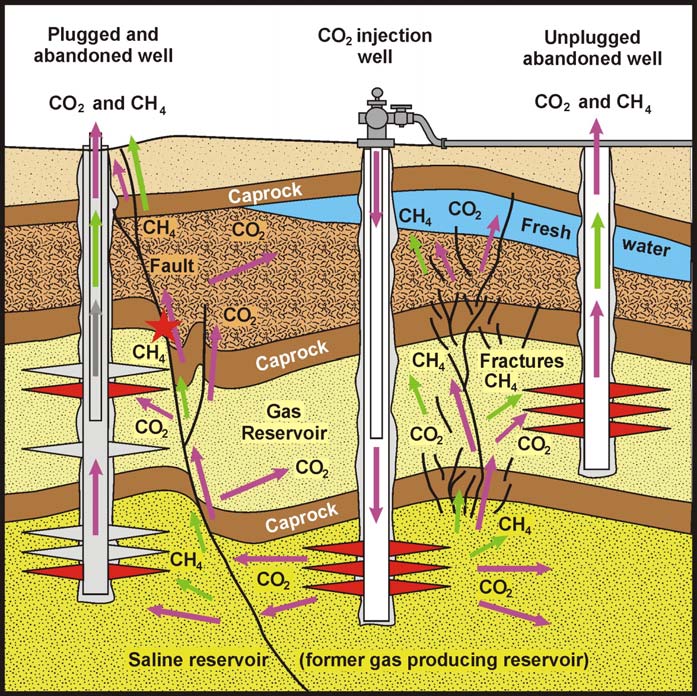
- CO2 and/or methane leakage out of the reservoir through faults and fractures, or through unplugged or improperly plugged wells
- Seismic events (earthquakes) associated with fault slippage or stressed cap rock
- Ground movement, particularly surface uplift resulting from overpressuring the reservoir
- Contamination of groundwater supplies
- Displacement of brine and/or CO2 into non-saline formations or adjacent formations (pore space) owned by third parties
- Porosity changes due to precipitation of minerals at or near the injection site
- Permeability changes due to swelling of in-situ minerals, deposition of contaminants within the injectate, and/or precipitation of minerals in reduced pressure zones away from the injection zone
- Solution of soluble minerals and redeposition as the solution becomes saturated with respect to CO2 or other constituents.
Legal Issues: The need to store the captured carbon has led to complex legal questions regarding the use and ownership of these potentially valuable spaces under our feet. Do these spaces belong to those who own the mineral rights or to the landowner? These issues have evolved from an old standard claiming that a property owner has title to all the space that extends from that property “up to heaven and down to hell,” so it is highly likely that in future CCS operators will need to obtain rights to pore space from the property owner. So far, in Pennsylvania, these issues have not been resolved. Although, under what’s called the “American Rule,” the state’s landowners possess the rights to the pore space under the surface of their property, no Pennsylvania court has so far addressed this question directly [The Value And Uses Of Pore Space As A Property Right – REALTORS® Land Institute].
In an effort to allow the state rather than the EPA to exert authority over the carbon capture process, Senator Gene Yaw recently introduced legislation titled the Pennsylvania Geologic Storage of Carbon Dioxide Act, which would create a legal and regulatory framework for CCS projects in Pennsylvania [Yaw: Carbon Capture, Utilization and Storage Shows Promise in Pennsylvania – Senator Yaw (senatorgeneyaw.com)]. It is not clear at this point what that framework would look like, although Senator Yaw has also introduced Senate Bill 831 (still under consideration) that begins to reveal his intentions. Yaw’s bill allows for pore space to be taken from unwilling landowners if the remaining owners of 60% of the required space have signed agreements to lease that space [Regular Session 2023-2024 Senate Bill 0831 P.N. 0921 (state.pa.us)]. In a scenario that looks eerily like the early days of fracking, landsmen representing a CCS company are already traveling around Washington County getting landowners to sign leases to allow carbon to be injected under their properties.
The bottom line: Pennsylvania is investing legislative time and effort in support of expensive and ineffective CCS technologies and appears to be working on developing a legal framework that will overburden our state’s environmental regulatory agencies and that will allow appropriation of homeowners’ rights to the subsurface beneath their property.
Download a formatted version of this factsheet
Additional Resources:
Carbon Capture and Storage and Pore Space
Some of the resources below do not reflect the position of the No False Solutions PA Coalition but are included to provide context.
Carbon Capture and Storage: Final Report, PennState
Carbon Capture Desperately Needs a Reality Check After Lost Decade, Akshat Rathi, Bloomberg
Carbon Capture Has a Long History. Of Failure. – Bruce Robertson, Bulletin of the Atomic Scientists
Carbon Capture Won’t Fix Our Climate Problem – June Sekera, Canada’s National Observer
Geologic Carbon Sequestration Opportunities in Pennsylvania, DCNR, 2009
A Low Carbon Energy Transition in Southwest Pennsylvania, Roosevelt Project, October 2021
The Pore Space Beneath Our Feet: What We Mean When We Say Carbon Storage – Sandra Steingraber, SEHN, 2024
Report of the Carbon Management Advisory Group, DCNR, 2008
Risk Assessment for Geologic Carbon Sequestration in Pennsylvania – Tetratech, 2010
Vulnerability Evaluation Framework for Geologic Sequestration of Carbon Dioxide, EPA, July 10, 2008
A Weak Spot in Carbon Sequestration: Abandoned Oil & Gas Wells – Nicholas Kusnetz, Undark
What’s the Deal with Carbon Capture and Storage – Cameron Oglesby, Yale Climate Connections
Find more information on our Resources page.
 No False Climate Solutions PA