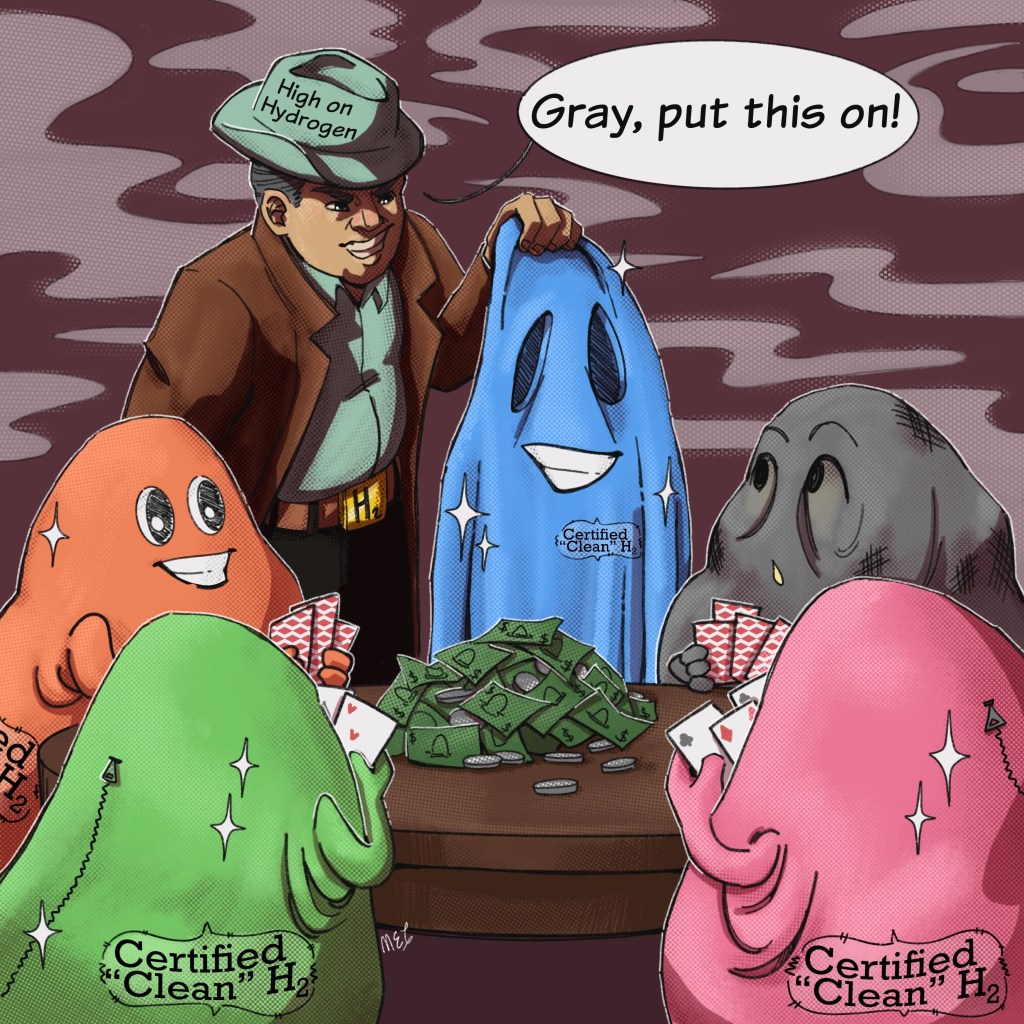
This week, our fossil fuel nemesis, Watery Green, is handing a blue hydrogen costume to a gray hydrogen molecule. Blue hydrogen is just gray hydrogen masquerading as “clean” hydrogen. Hydrogen can be produced many ways, so scientists have taken to assigning colors to the different forms according to the feedstock and production process. Gray signifies dirty hydrogen made from methane using steam methane reforming. Blue is exactly the same except that carbon capture and storage (CCS) is added to the process. If you followed Week 1 of PA Energy Month, you know that CCS is a sham. But even if it wasn’t, even if it captured all of the CO2 emissions and permanently sequestered them, it would never address all of the climate-killing methane emissions that come from producing the feedstock and powering the process.
The other hydrogen molecules gambling with gray already in their “clean” costumes are pink (nuclear), orange (“renewable natural gas”), and green (renewable energy). There are other colors on the hydrogen rainbow, but these four are the forms proposed for the hydrogen hubs that will affect Pennsylvania. The ARCH2 hub in western PA, OH, and WV is a straight up blue hydrogen hub. The MACH2 hub in Philadelphia, southern and central NJ, and DE claims it won’t produce ANY blue hydrogen (although that was part of the plan as originally stated), but will produce pink, orange (from biomethane), and green.
Watery Green is trying to sell you on the idea of “clean” hydrogen, but there is no such thing. Even green, made from renewable energy using electrolysis, is dirty.
To paraphrase Gertrude Stein, hydrogen is hydrogen is hydrogen. It can be produced from various feedstocks and processes. Regardless of how it was made, however, the end product is the same. Hydrogen is the smallest molecule and a highly volatile one that is prone to leaking, especially from pipelines it compromises, a process called hydrogen embrittlement.
Hydrogen is an indirect greenhouse gas. Its presence in the atmosphere deprives methane of the hydroxyl it needs to convert to CO2 and water vapor, thereby extending methane’s life. That interference earns hydrogen a global warming potential (GWP) 35 times greater than that of CO2 in the 20-year time scale.
And even though green hydrogen doesn’t emit CO2, it pollutes the air with NOx emissions.
But the story of hydrogen gets even worse. The Department of Energy has been promoting the concept of Hyblend pipelines that add hydrogen to existing natural gas pipelines. Those pipelines deliver the blend to homes, schools, hospitals, and businesses. Appliances aren’t capable of handing the percentage of hydrogen some utilities are trying to put in the pipe. Check our Hydrogen Blending Tracker to see if there’s a project planned in your community.
Watery Green has a lot of allies in Washington and Harrisburg. Billions of your tax dollars are being spent on developing seven regional hydrogen hubs including the ARCH2 and MACH2. Proponents of hydrogen say it can address “hard to abate” sectors of the economy, but there’s no proof it can be done safely or cost effectively.
Check out our Hydrogen Hubbub site for more information!
TAKE ACTION!
Another great way to find out more on hydrogen is a webinar The Hydrogen Regulatory Landscape hosted on October 16 at 6:30 ET by the Delaware Riverkeeper Network. Maggie Coulter, Senior Attorney with the Center for Biological Diversity, and Kacy Manahan, Senior Attorney with the Delaware Riverkeeper Network are the scheduled speakers. Register NOW!
Sign the petition to the President Biden and the Department of Energy called Don’t Erase Real Climate Action with Hydrogen Hype; Protect Our Communities
 No False Climate Solutions PA
Leave a comment